Français
 Deutsch
 Nederlands
 Italiano
 Español
Graphic design plays an essential role in the music industry. Album covers, concert posters, Merch, and visual identities: behind every creation lies work that combines artistic sensibility, listening, and collaboration with artists. For this new interview dedicated to music industry professions, we meet Førtifem, the duo made up of Jesse and Adrien, whose distinctive graphic universe leaves its mark on numerous music projects!
Hi Jesse, Adrien. Thank you for taking the time to answer our questions! Before Førtifem, what were your respective backgrounds in graphic design?
Hello Distrolution Merch, and thank you!
In terms of education, we both went through graphic design schools — Adrien at an Applied Arts school in Troyes, and Jesse at the Fine Arts school in Caen, studying graphic design. After that, Adrien worked at advertising agencies as an Art Director on the web side for 5–6 years at Publicis and Ogilvy, and Jesse worked as a freelancer in print and a bit in web.
In 2012, you decided to join forces under one name. How was Førtifem born?
When we met, we both still had our respective day jobs, and the idea of working together wasn't really on the table, but we both had a great love for illustration. Adrien would occasionally make flyers and posters for bands, and Jesse did personal illustrations. We started drawing together for fun, and Olivier Marescaux, a screen-printing friend of ours, suggested organizing an exhibition in Reims — it was what we produced for that exhibition that got us started. From there, we began receiving requests from bands and labels to create album covers or logos; we'd do it in the evenings after work… and then at some point, it started taking up a lot of our time, and we decided to try focusing on it 100%. More than ten years later, we're still at it!
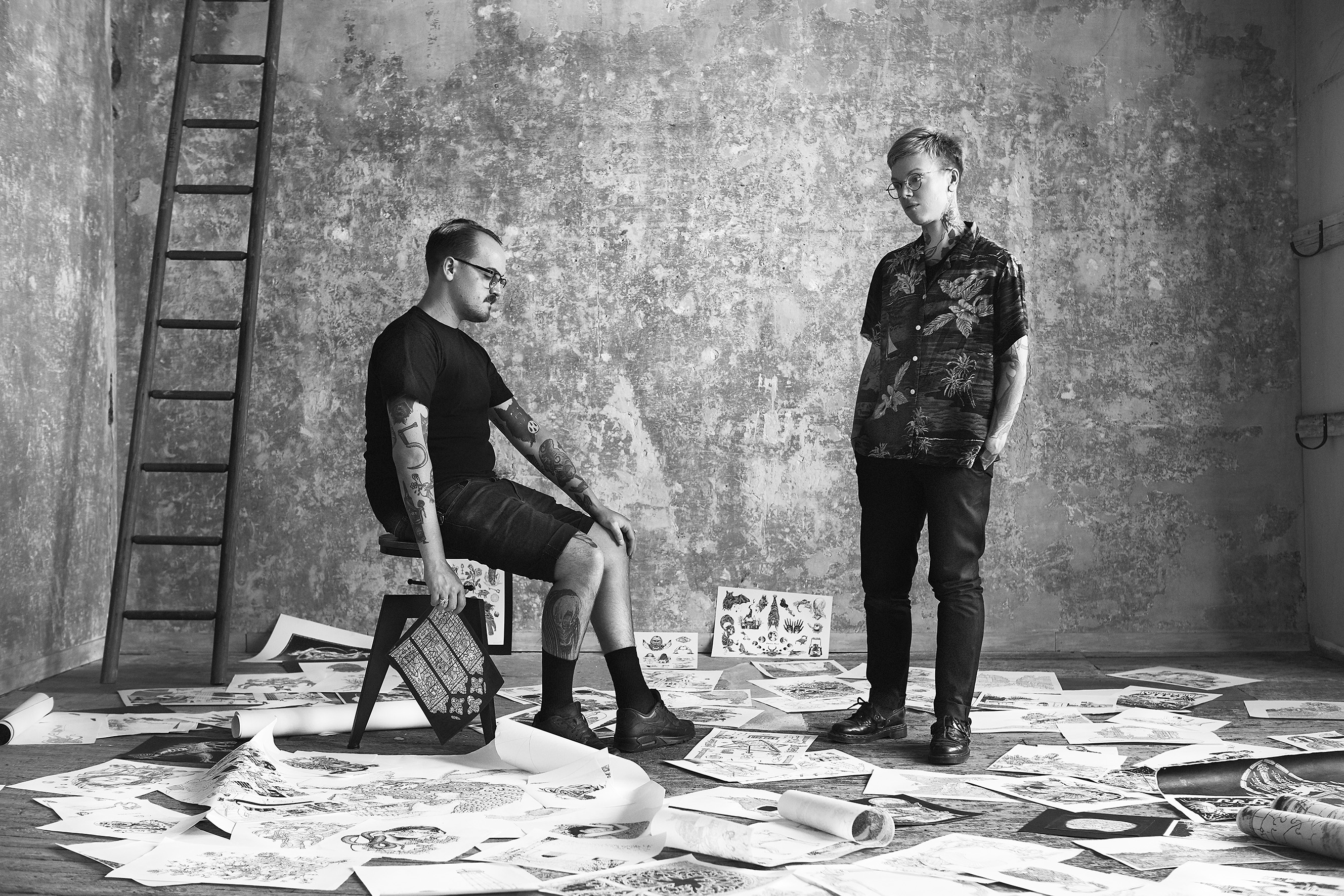
Photo - DR - Credit: William Lacalmontie
Your style sits somewhere between tattooing and old-fashioned engraving. How did this visual identity take shape over time?
Tattooing and engraving were two worlds we had in common right from the start — black line work, occult references, monsters, religion, and alchemy. We don't draw in the same way, but we use it to express similar things. So it came about quite naturally; there was no deliberate decision to pursue a particular style. Even now, we struggle to define what our "style" is — but if what we do is recognizable, that's great. At the beginning, we only worked in black and white, but it was the requests of certain clients (Carpenter Brut in particular, not to name anyone) that led us to add color. We can easily stay in our comfort zone, but we love being pushed out of it.
Can you describe the main steps of your creative process, from the first discussion with the client through to the final visual?
It really depends on the project, but in general, we ask the client for as many elements and sources of inspiration as possible right from the start — the music obviously if we're working for musicians, things they like visually in our work or in others'. We prefer commissioned projects with an idea, a minimum level of definition, over blank-slate briefs: 90% of the time, the person commissioning the work inevitably has the seed of an idea that they don't dare or can't quite conceptualize and express.
After these initial exchanges, we'll sketch one or more directions and develop one of them more precisely. We try as much as possible to validate all the details at the sketch stage before moving on to the final visual. Finally, most of the time, we work on color last. We also often try to move quickly from sketch to final, to preserve the momentum and keep the energy we dedicate to the project pure and intact, rather than diluting it over time.
With such a dense and prestigious portfolio, is there a project that has particularly stood out for you in a positive way, either for its scale or its creative freedom?
We're torn between the time we received an email from a certain Tomas, explaining with great politeness that he was in a Norwegian black metal band and that he'd like us to redo their coat of arms — that band was Emperor.
Our inner teenage selves couldn't believe it. Then, the biggest project we ever did was Major Arcana in 2019 — and we'll never get over that episode. Red Bull was organizing a music festival in Paris and asked us to design an ambitious evening to put on a metal night within that edition, combining image and music, something "never seen before," telling us that money was no object.
We ended up inviting dozens of friend bands and friends-of-friends, offering them this wild idea: to play joint sets on stage, with an animated visual backdrop built from our illustrations scrolling behind them, all on the grand stage of the Trianon.
The line-up settled on three collaborations eternally etched in our hearts: Nostromo & Treha Sektori, Hangman's Chair & Regarde les Hommes Tomber, and Alcest & Perturbator.
In the backup plans — it's a secret — we had Amenra and also Ulver.
Red Bull, Monster, or any other powerful multinational can-holding company — if you're reading this, we're up for doing it again.
Conversely, what was the most significant challenge you had to face, and how did you manage to overcome it?
Our biggest constraint in general is time — sometimes we need to come up with an idea or a layout very quickly when we'd love to be able to take the time to dig deeper, test things, challenge the obvious choices. But more specifically, at one point we had an album cover project where everything had been signed off, the cover was almost ready, and then one of the members didn't feel it represented them… The decision was made to start from scratch. In the end, we're very happy with that choice and the second cover was much better, but when we were in the thick of it, it wasn't easy to redo everything while keeping the original energy. Fun fact: it's a band mentioned in this interview. Ordeals are quickly forgotten, whereas a record cover lasts forever.
How do you view the illustration profession today, particularly in the digital and AI era, when your practice remains deeply rooted in hand-drawn work?
We've drawn very little on paper for a few years now — the pace imposed particularly by the publishing world somewhat forced us to go digital in order to save a few hours we can spend sleeping. No more scanning, no more cleaning up paper or lines, and if there are changes to be made, we don't have to redo the whole drawing! But it's not the same practice — it's less immersive to be in front of a screen than in front of a sheet of paper, so we hope to get back to it a bit more at some point. The emotion in front of an original drawing is incomparable to that in front of a file.
As for AI, yes, it's been the big debate for a few years now, and we'll have to accept that it's not going to stop. We're fortunate to have started our careers before all of that and to have developed a style and a know-how that means people come to us with a specific idea in mind — and (for now?) AI can't produce what we do. But for people launching an artistic career right now, it must be dizzying.
Beyond the ethical and ecological issues, it's also a double-edged thing: on one hand, AI now allows people to be able to express their ideas visually. On the other: it can lock them into a particular iconography and reduce our creative range and our ability to surprise them.
Finally, for people who use AI to generate finished products — festival posters, Merch, album covers — we find it genuinely sad to deprive yourself of the chance to collaborate with visual artists, especially when the offering has never been more vibrant.
Finally, what advice would you give to people who want to get into graphic design?
Just do it. Simply. Do it and get paid as much as possible, as soon as possible.
We've worked with huge bands, but it only happened by starting with small ones, then medium-sized ones, always putting in the same care and attention. If you love a band, don't hesitate to pitch your work to them, while making sure not to fall into an asymmetric dynamic: keep it a collaboration where each party needs the other and everyone benefits, in order to produce something beautiful or powerful.
Concerts need posters, bands need Merch. And even, make stuff for yourselves, among yourselves. You'll meet screen printers who need images to print, organizers who'll give you the chance to have fun with flyers and experiment. We're all working together to make the world cooler, one image at a time.