Français
 Deutsch
 Nederlands
 Italiano
 Español
For this new interview dedicated to music professions, we go to meet Antoine LANAU, freelance graphic designer and illustrator.
An interview that takes us behind the scenes of a profession where creativity, curiosity and business management must coexist on a daily basis.
Hi Antoine! To start, can you introduce yourself in a few words? How did you become a freelance illustrator and graphic designer?
Hi Valentine! My name is Antoine Lanau, I've been a freelance illustrator and graphic designer since 2018. I work primarily for the amplified music scene (hardcore/punk/rock/metal), creating merch visuals, album covers, festival posters, etc. I also really enjoy designing logos.
I started my business after 9 years in the restaurant industry. During that time, I was already drawing and started to get a few requests here and there. I was also touring with my bands (Fire At Will and Skull Soda), but combining that extremely demanding profession with the life of a musician plus illustration started to become unliveable. So I plucked up the courage and took the plunge by creating my sole-trader business.
I learned on my own, I have no degree and never followed any academic curriculum.
You currently work in very distinct worlds — rock, metal and board games. Was that obvious from the start, or did your journey gradually lead you towards those sectors?
It was not at all obvious. I started by working for bands because I was part of the Toulouse hardcore scene and my network was built through that. Even today, most of my illustration work is for artists, festivals or music producers. It was through various encounters in life that I was able to explore other worlds: board games as you mention, but also large and small companies, private individuals, etc. Each time, it was a meeting or an exchange of contacts that allowed me to branch out into different creative sectors.
What does a typical day in the life of a freelance graphic designer look like?
I can only speak for myself, but to be honest I'm so disorganised that I don't have a typical day haha. But to give a proper answer: I start by reading my emails, I look at the projects in progress and what needs to be finished / edited / started, then I get to work. I'm more efficient in the morning so I make the most of that time to work. In the afternoon, unless I'm forced to by an urgent deadline, I prefer to do something else, and I often pick things back up at the end of the day.
All of that I do, but not always in that order, especially since for a creative, everything that happens in life can feed your work — it's therefore important for me to go and recharge outside, live through things, otherwise I quickly go in circles and my imagination dwindles.
Can you describe the main steps of your creative process, from the first conversation with the client to the final visual?
I always start with a face-to-face conversation when possible (via video call or phone), as it's more fluid for exchanging ideas, understanding and feeling what the client wants. Once the brief is established, I draw up a quote with a full description of the project. If it's approved, I get to work by doing some inspiration research (sometimes I also start directly) and then move on to sketches. I can do one or several, depending on the project.
Once satisfied, I send the sketch to the client; at this stage, the visual is very rough: it's a pencil drawing in grey that simply lays out the foundations of the composition and style but contains very few details. Once approved, I move on to inking and then colouring. I work almost exclusively on a graphics tablet with Photoshop, but I occasionally draw on paper. Again, it all depends on the project.
For a logo, my process is broadly the same.
As a musician, does your experience on stage influence the way you create visuals for bands or festivals?
Yes, because there are graphic codes specific to each musical style that must be respected. So you need to have at least a minimum interest in what's out there, especially since trends change quickly; that certainly influences my style. Today, my activity as a musician is very sporadic, so I find inspiration mainly online and in books, but it's clear that playing an instrument in a band and the life that comes with it gives you a better understanding of that world.
Was there a project or an encounter that marked a turning point in your career?
There have been several, but I'm thinking of one moment in particular. At Hellfest in 2019, I had the opportunity to meet Adrien and Jesse, two talented illustrators known as Fortifem. I already knew their work and was rather shy about meeting them — I had very little confidence in myself at the time. We talked about life as an illustrator when I was just starting out. Since then, Adrien has often recommended me to clients for whom they didn't have time to respond to positively. This led me to work for bands and players on the scene who were more "established," and it makes an obvious difference to my portfolio today. I'm very grateful to him for the trust he places in me by passing my details on to those clients.
What are, in your opinion, the essential qualities needed to be a graphic designer (beyond having a talent for drawing, of course!)?
I'll draw a distinction here between graphic design and illustration.
Graphic design is an activity that requires an interest in the various elements of communication such as typography, layout, the meaning of colours and shapes, etc. Being curious about communication trends and being rigorous in your learning is important. It is also essential to learn how to use the associated software (Adobe Suite or Affinity).
For illustration it's a little different. Knowing the basics like perspective or anatomy is a big plus of course (so rigor does come into play), but it's above all the desire to create that matters in my view. All techniques are then possible and you always improve with time. What I mean is that it's not necessary to know how to draw "well" to get started — you just have to… draw. Observe the world, be curious, copy the works you love (very important for learning) and develop your imagination. Technique is secondary. It's the style that will then take over, and therefore the personality of the artist.
My work leads me to navigate between these two worlds.
In both cases, it is also necessary to go through the business management stage, because remaining profitable with a creative activity is difficult, especially today with social media having shaken up the codes of communication. I'm still learning today how to use social media correctly to stay visible — an absolute nightmare for me haha.
The graphic design profession is evolving rapidly, particularly with the arrival of new tools such as artificial intelligence. How do you perceive these developments and their impact on your work?
I am anti-AI on principle. We could do an entire interview on that subject alone, so I'll try to keep it brief.
The very nature of generative AI is an aberration, since its algorithms train freely on all images published on the internet. This raises a great many ethical and moral issues related to intellectual property and copyright. The United States, the cradle of the system, imposes its law in this domain without any oversight, study, debate or challenge. The Trump administration uses it excessively to serve its political agenda and encourages its development in contempt of all common sense. This is not insignificant.
It should be added that its operation is made possible by servers (the famous data centers) which are an ecological disaster. They require deforestation and the paving over of land, and consume an aberrant amount of water (to cool the machines). In short, capitalist imperialism in all its horror.
It is very difficult for me today to remain confident in the face of this phenomenon. It's moving too fast, it's impossible to predict what will happen, and most of the studies I've read are very alarmist on the subject.
To refocus the debate on its direct impact on my work: I don't believe there is any effect for the moment. Clients who call on an artist are looking for a style, a singularity, a personality. AI cannot provide that, since it merely copies and regurgitates soullessly what it records, which is already leading to a visual uniformity that people are starting to notice. You can see movements online expressing a backlash against this visual "soup" on social media.
I'll stop here because I could still say a lot more and the subject evolves every day.
To conclude this interview, tell us about your current projects (if you can reveal a few)?
I just finished one of the biggest illustrations I've ever done for an album cover, so I can't wait to be able to unveil it. I have other artworks for albums and merch in progress, as well as festival posters for 2027.
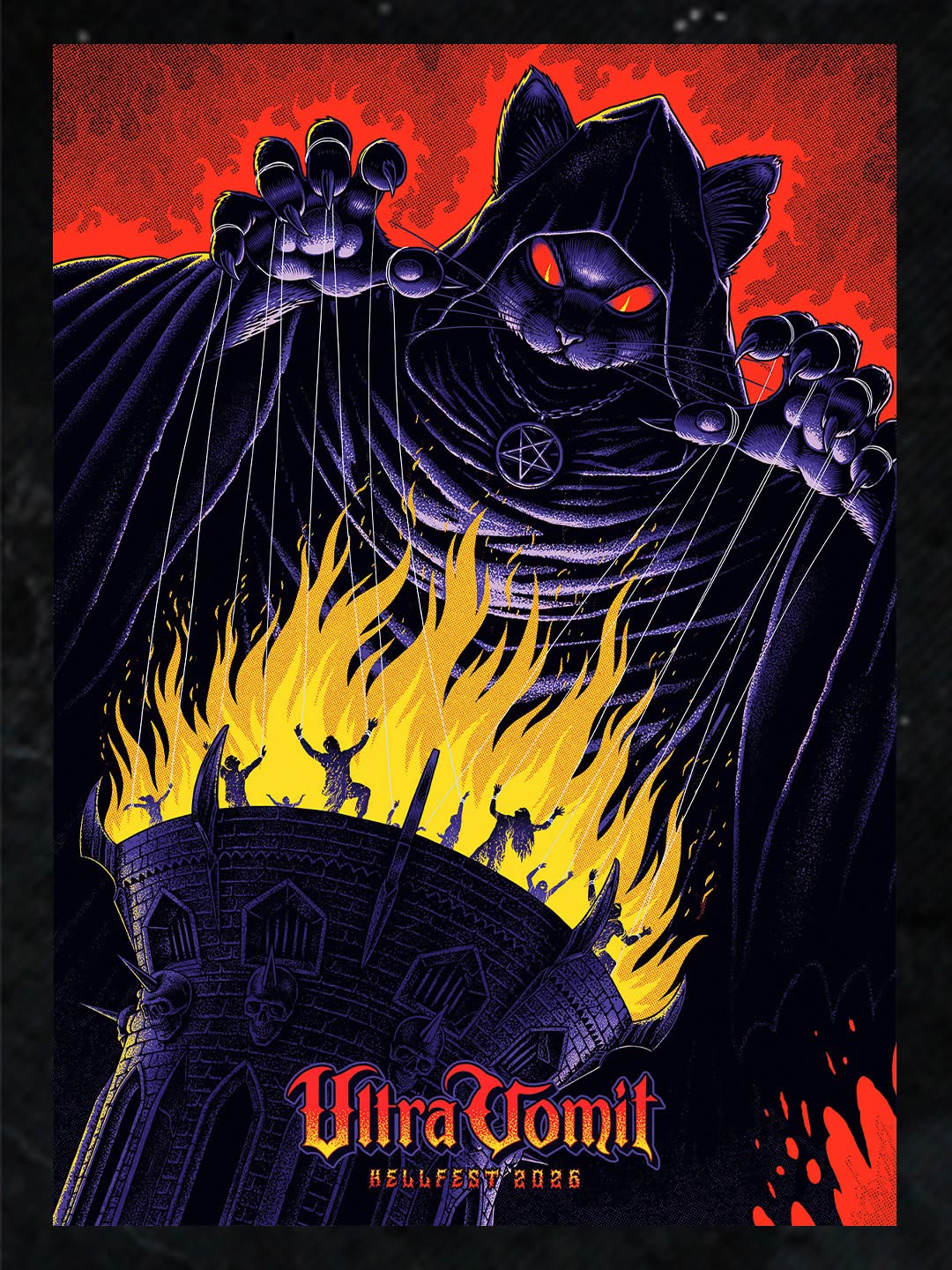
On another note, I recently got to work for Ultra Vomit by creating a screen-printed poster for their appearance at Hellfest. That gave my work a nice moment in the spotlight this summer, which is always welcome.
Thank you for your time, Valentine!